From Perrier to On-Site Sparkling Water Production: How Much Can Restaurants Reduce Their Sparkling Water Costs?
Switching from purchasing cases of bottled Sparkling Water to producing it on site changes more than just the supply method.
Over time, restaurants can reduce not only bottled-water purchasing costs, but also the ongoing hidden costs of logistics, handling, storage, refrigeration, and empty-bottle management.
With one commercial sparkling water system investment, restaurants can maintain a stable supply of Sparkling Water for both everyday table service and high-volume bar applications. As usage increases, the fixed investment can be spread across more servings, making the overall supply cost more efficient.
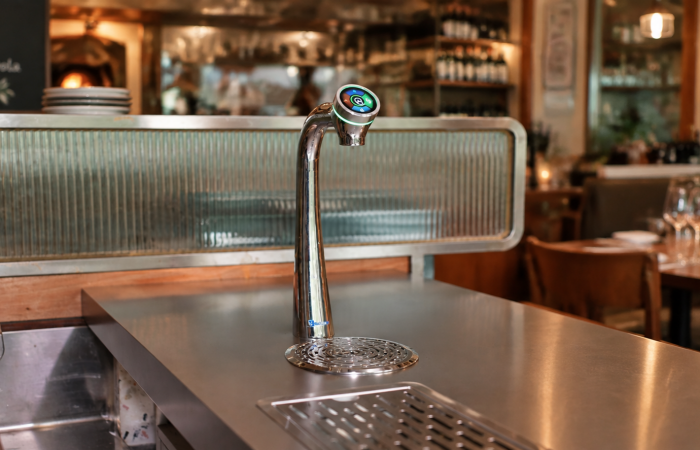
Table of Contents
- 1. Bottled Sparkling Water: The Real Cost Goes Beyond the Bottle Price
- 2. How a 4-in-1 Commercial Sparkling Water System Can Change the Cost Structure
- 3. Is the Equipment Investment Worth It? How to Calculate the Payback Period
- 4. Conclusion: From One Bottle of Sparkling Water to a Complete Supply System
1. Bottled Sparkling Water: The Real Cost Goes Beyond the Bottle Price
a. Purchase Cost: Every Bottle Comes with a Fixed Cost
Take Maison Perrier 330mL glass bottles as an example. Current U.S. foodservice pricing is around US$43.99 per 24-bottle case, or approximately US$41.99 per case when ordering 16 cases or more. This equals roughly US$1.75–1.83 per bottle.
100 bottles/day × 30 days = 3,000 bottles/month
Bottled-water purchasing cost:
Approximately US$5,250–5,500/month
b. Logistics, Handling, and Storage: The Additional Operating Costs Behind Bottled Water
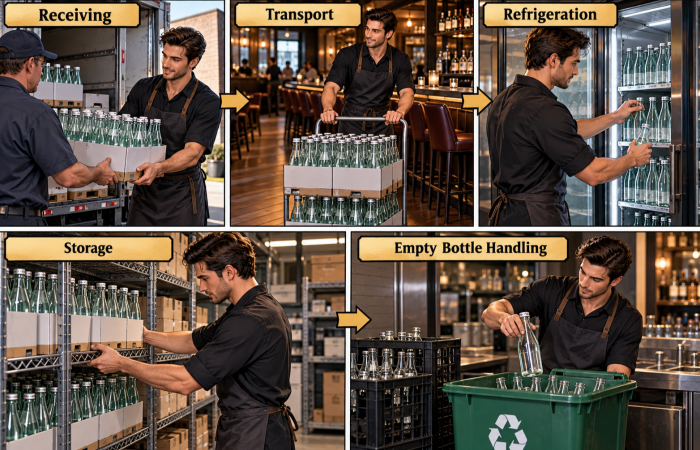
The cost of bottled water does not stop at the purchase price. At 100 bottles per day, a restaurant receives around 3,000 bottles, or 125 cases, every month. These products need to be delivered by suppliers, received by the restaurant, unloaded, moved, stored, refrigerated, and restocked for service.
For restaurants, transportation involves more than just water. Glass bottles and outer packaging also add weight and handling requirements. As bottled volume increases, the need for storage space, refrigeration capacity, inventory organization, and empty-bottle handling also increases.
These small operational tasks also represent labor costs. In the U.S., food and beverage serving-related jobs typically have median hourly wages around US$15–17/hour, while restaurant labor costs in China vary significantly by region. Even if staff spend only several minutes each day receiving, moving, organizing, and managing bottled water, the accumulated labor cost over a month can become meaningful.
In addition, restaurants often maintain safety stock to avoid running out of products, which further occupies storage space and increases the risk of slow inventory turnover or excess stock.
c. Fixed Bottle Sizes: Potential Waste in Beverage Preparation
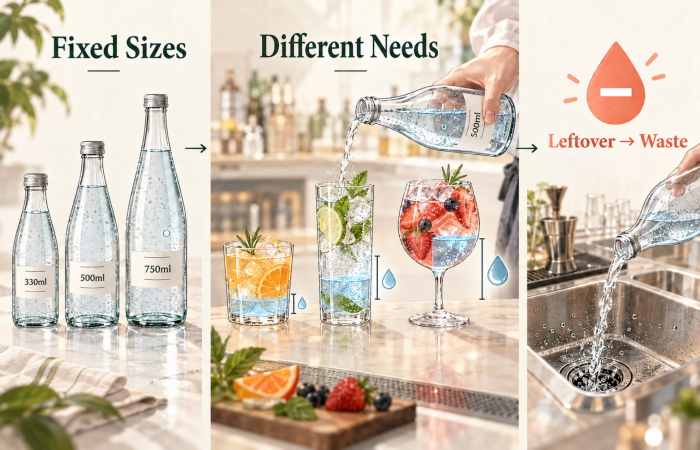
Bottled Sparkling Water is usually sold in fixed sizes such as 330mL, 500mL, or 750mL, but restaurant applications do not always match these formats perfectly.
For example, when bars prepare Highballs, Spritzes, or other mixed drinks, recipes may require different amounts of sparkling water. Fixed bottle sizes can create leftover product, additional bottle-opening management, and inventory-matching challenges.
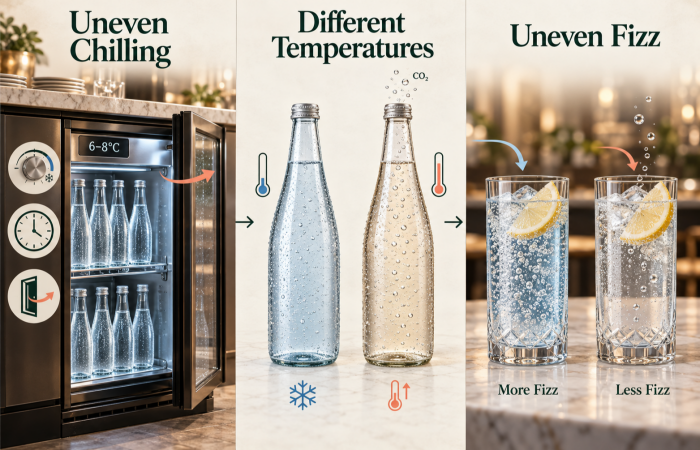
d. Inconsistent Chilling Temperatures Can Affect Sparkling Beverage Consistency
Besides purchasing, transportation, and storage costs, bottled Sparkling Water performance can also be affected by refrigeration conditions.
Bottled sparkling water is usually chilled before service, but the actual temperature can vary depending on cooler settings, storage time, door-opening frequency, and bottle placement. Many restaurant refrigeration environments operate around 6–8°C, but the time required for bottles to reach the desired serving temperature is not always consistent.
For sparkling beverages, water temperature directly affects how CO₂ dissolves and remains in the water. Higher temperatures can accelerate CO₂ release, reducing the sparkling sensation and bubble persistence. Different batches of bottled water stored under different conditions may therefore create variations in the final drink experience.
2. How a 4-in-1 Commercial Sparkling Water System Can Change the Cost Structure
a. Moving from Bottled Purchasing to Instant On-Site Production
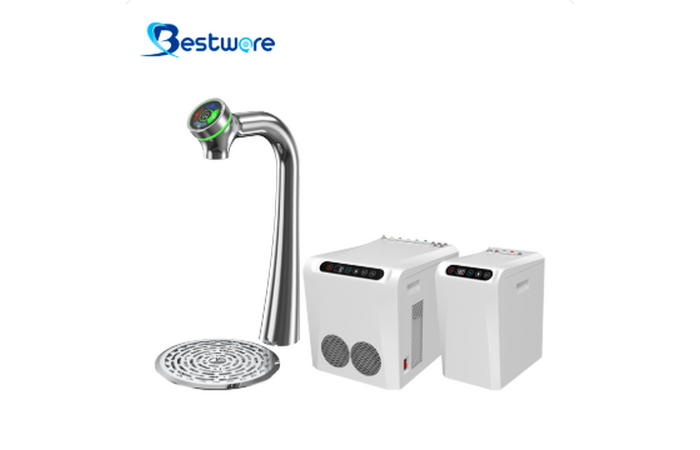
Bestware’s 4-in-1 commercial sparkling water system integrates filtration, instant chilling, and carbonation in one system, providing ambient water, chilled water, hot water, and sparkling water.
When a restaurant needs Sparkling Water, filtered water can be chilled and carbonated instantly on site, creating a Sparkling Water On Tap experience: produced on demand and dispensed immediately.
For temperature control, Bestware allows chilled water and sparkling water temperatures to be adjusted within a 0–8°C range with stable temperature settings, reducing fluctuations caused by refrigeration time, ambient temperature, and storage conditions.
At the same time, the system controls the combination of CO₂ and water to maintain carbonation at approximately 3 Vol. 3 Vol can be understood as roughly 3 liters of dissolved CO₂ per 1 liter of water, providing a clear sparkling sensation while remaining suitable for direct drinking and foodservice applications.
By controlling both water temperature and carbonation intensity, restaurants can reduce variations caused by temperature changes and manual operation differences, creating a more consistent experience across different service times and shifts.
b. On-Site Production Changes the Cost Calculation
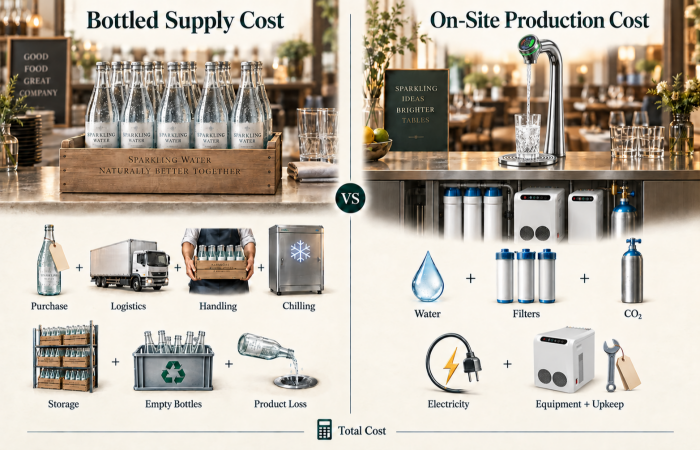
Bottled supply cost = bottled-water purchase + logistics + handling labor + refrigeration + storage + empty-bottle management + product loss
On-site production cost = water + filtration consumables + CO₂ + electricity + equipment investment and maintenance
The two models cannot be compared only by purchase price because on-site production also involves operating costs. However, on-site supply reduces many of the packaging, logistics, storage, and labor-management costs associated with individual bottles.
c. Costs Reduced Compared with Bottled Supply
On-site production reduces the need to continuously purchase large volumes of finished bottled water; reduces receiving, handling, inventory management, and refrigeration requirements; reduces empty-bottle and packaging-related costs; and reduces waste caused by fixed bottle sizes not matching actual usage.
3. Is the Equipment Investment Worth It? How to Calculate the Payback Period
a. Each Restaurant Should Evaluate Based on Its Own Operating Data
Different restaurants have different customer volumes, Sparkling Water usage, bottled-water purchasing prices, local CO₂ costs, and operating expenses. Therefore, the value and payback period of the equipment will vary by location and usage pattern.
b. Basic Calculation Method
Monthly savings = Total bottled supply cost − Total on-site production cost
Payback period = Total equipment investment ÷ Monthly actual savings
Total bottled supply cost includes purchasing, transportation, storage, refrigeration, handling, and empty-bottle management.
Total on-site production cost includes water, filtration consumables, CO₂, electricity, equipment depreciation, and maintenance.
c. High-Usage Applications Show the Value More Clearly
If a restaurant only serves a small amount of Sparkling Water each day, bottled supply remains a simple and direct option. However, when Sparkling Water becomes a regular table beverage or is also used for bar preparation, purchasing, logistics, storage, and labor-management costs continue to increase with volume.
4. Conclusion: From One Bottle of Sparkling Water to a Complete Supply System
Restaurants should not only calculate the price of one bottle. They should calculate the complete cost behind supplying that bottle.
Bottled supply requires continuous purchasing, transportation, storage, and labor management. On-site production transforms the supply model into a system that operates according to actual demand.
For restaurants that already serve Sparkling Water as a regular table beverage or a common bar ingredient, a commercial sparkling water system provides another option: reducing repeated costs from the bottled supply chain while maintaining a stable, on-demand beverage supply.